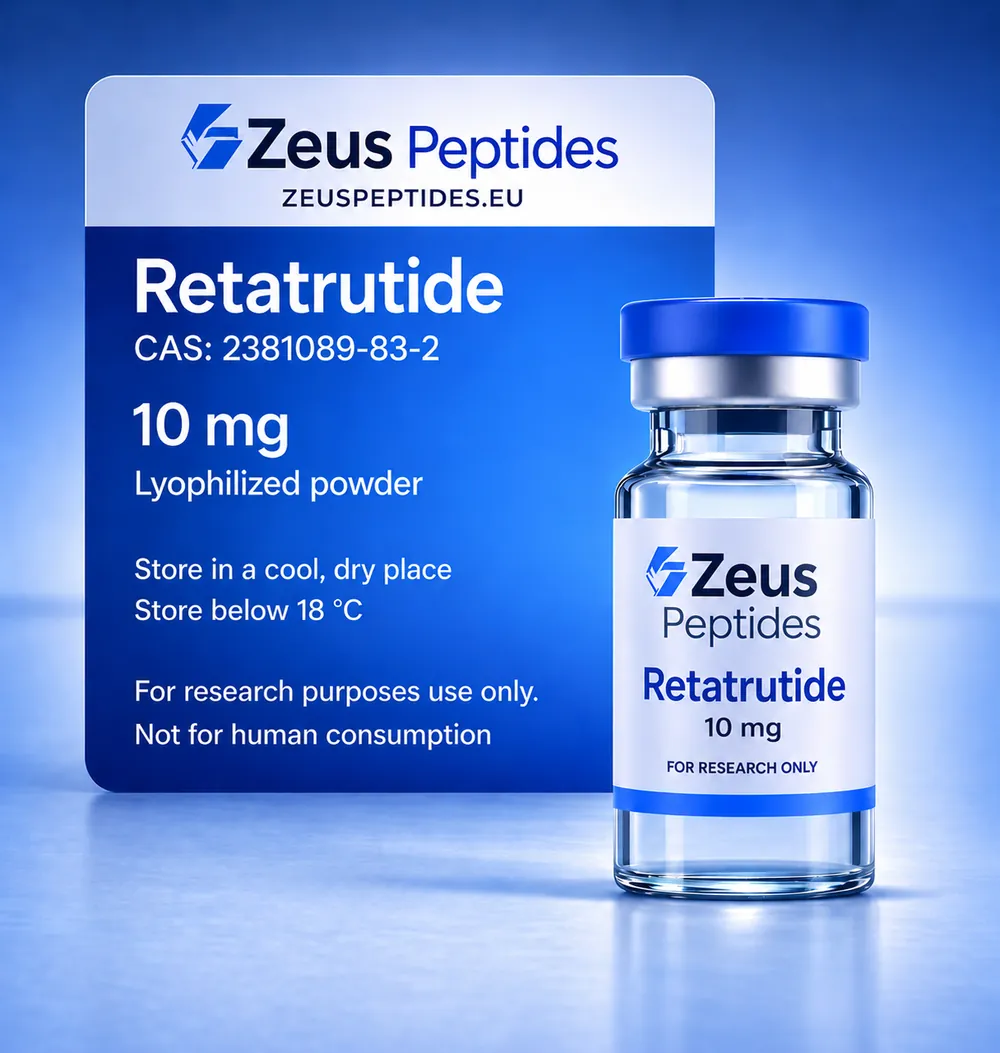
Retatrutide 10 mg — for laboratory research
€12.00 per mg
1 Products
Standard
€120,00
/each
3 Products
5% OFF
€114,00
/each
6 Products
10% OFF
€108,00
/each
8 Products
15% OFF
€102,00
/each
Independent lab report for this batch
- Independent lab
- Janoshik Analytical
- Batch number
- R10-05-2026
- Measured purity
- 99.126%
- Measured content
- 10.73 mg / 11.07 mg
- Analysed on
- 18 June 2026
Secure payment via

'%3e%3cpath%20d='M780%200H0V500H780V0Z'%20fill='%231434CB'/%3e%3cpath%20d='M489.823%20143.111C442.988%20143.111%20401.134%20167.393%20401.134%20212.256C401.134%20263.706%20475.364%20267.259%20475.364%20293.106C475.364%20303.989%20462.895%20313.731%20441.6%20313.731C411.377%20313.731%20388.789%20300.119%20388.789%20300.119L379.123%20345.391C379.123%20345.391%20405.145%20356.889%20439.692%20356.889C490.898%20356.889%20531.19%20331.415%20531.19%20285.784C531.19%20231.419%20456.652%20227.971%20456.652%20203.981C456.652%20195.455%20466.887%20186.114%20488.122%20186.114C512.081%20186.114%20531.628%20196.014%20531.628%20196.014L541.087%20152.289C541.087%20152.289%20519.818%20143.111%20489.823%20143.111ZM61.3294%20146.411L60.1953%20153.011C60.1953%20153.011%2079.8988%20156.618%2097.645%20163.814C120.495%20172.064%20122.122%20176.868%20125.971%20191.786L167.905%20353.486H224.118L310.719%20146.411H254.635L198.989%20287.202L176.282%20167.861C174.199%20154.203%20163.651%20146.411%20150.74%20146.411H61.3294ZM333.271%20146.411L289.275%20353.486H342.756L386.598%20146.411H333.271ZM631.554%20146.411C618.658%20146.411%20611.825%20153.318%20606.811%20165.386L528.458%20353.486H584.542L595.393%20322.136H663.72L670.318%20353.486H719.805L676.633%20146.411H631.554ZM638.848%20202.356L655.473%20280.061H610.935L638.848%20202.356Z'%20fill='white'/%3e%3c/g%3e%3cdefs%3e%3cclipPath%20id='clip0_6278_125833'%3e%3crect%20width='780'%20height='500'%20fill='white'/%3e%3c/clipPath%3e%3c/defs%3e%3c/svg%3e)




Retatrutide research-grade lyophilized peptide powder in a glass vial. Retatrutide (LY3437943) is an investigational multi-receptor peptide agonist that targets GIP, GLP-1 and glucagon receptors, used in experimental models of obesity, glycemic control and metabolic regulation.
Research Use Only: All products are intended exclusively for laboratory and scientific research. Not for human or veterinary use.
Technical Specifications
Frequently asked questions
Retatrutide: compare vial sizes
| Product | Nominal content per vial | Price | Availability | Documentation |
|---|---|---|---|---|
| Retatrutide 10 mg (this page) | 10 mg | €120.00 | In stock | Published report, batch R10-05-2026 |
| Retatrutide 20 mg | 20 mg | €220.00 | In stock | Batch report on request |
| Retatrutide 30 mg | 30 mg | €300.00 | In stock | Batch report on request |
FAQ on vial content and documentation
What is the difference between the vial sizes?
It is the same compound; only the nominal amount of lyophilisate per vial differs. The measured amount of a specific batch is stated in its report.
Where do I find the batch number?
The batch number is printed on the vial label. Compare it with the batch number in the report; the report only belongs to your vial when the numbers match.
Which report belongs to this size?
For Retatrutide 10 mg a Janoshik Analytical report has been published for batch R10-05-2026 (analysed on 18 June 2026). It applies only to that batch and this vial size, not to other sizes.
Where do I find documentation and how do I verify it?
Published reports are listed on the lab results page. An original report can be checked with Janoshik Analytical's verification form using the task number and unique key from the report. The COA guide explains how to read a report.
Research context
Retatrutide (LY3437943) has been described in the literature as an agonist of the GIP, GLP-1 and glucagon receptors. A randomised phase 2 study was published by Jastreboff et al. This publication says nothing about the quality, composition or effect of our vials.
Source: Jastreboff AM et al. N Engl J Med. 2023. PMID 37366315 — PubMed · DOI
Intended exclusively for laboratory research and research purposes. Not for human or animal consumption.
Also known as
- retatrutide
- reta
- reta peptide
- retatrutide peptide
- retatrutyd
- retatrutide pen
- LY3437943
Also searched as: retatrutide kopen, retatrutide kopen nederland, achat retatrutide.
All listed variants refer to the same research material, supplied strictly for laboratory research and research purposes only.
Frequently asked questions about these search terms
Research Overview
Retatrutide is a next-generation multi-agonist peptide that engages GIP, GLP-1 and glucagon receptors simultaneously. It is used in laboratory and preclinical models to study integrated control of body weight, glucose homeostasis and whole-body energy balance.
Primary Research Areas
- Triple GIP/GLP-1/glucagon receptor agonism: mechanistic studies dissecting receptor pharmacology and downstream pathways.
- Obesity & body-weight regulation models: in vivo models exploring changes in body weight, adiposity, and food intake.
- Glycemic control & metabolic health: research on glucose tolerance, insulin dynamics, and hepatic glucose output.
More research on Retatrutide
Explore preclinical studies, mechanisms of action and references for Retatrutide.
View researchFor Research Use Only
This product is intended solely for in-vitro research and laboratory use. Not intended for human consumption, diagnostic or therapeutic purposes.
Safety & Handling
Handle with appropriate protective equipment (gloves, lab coat, eye protection). Store according to product specifications. Consult the Safety Data Sheet (SDS) for full safety instructions.