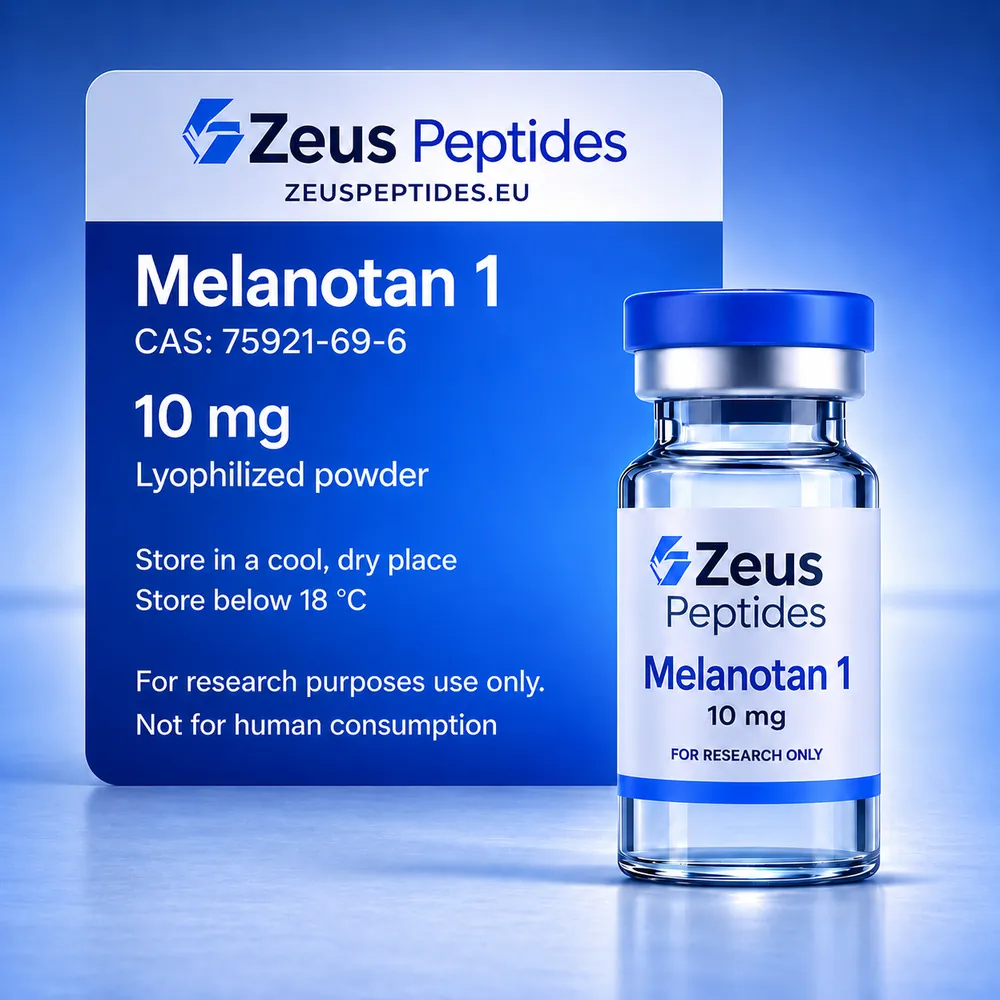
Melanotan I and Melanotan II are frequently used interchangeably online, even though they are two structurally distinct molecules with their own research history. This article lays out the differences factually and, as in our article on Melanotan 2, deliberately and critically addresses the known risks and the absence of marketing authorization — without any encouragement to use these substances.
What is Melanotan I?
Melanotan I (also abbreviated as Melanotan-I or MT-I) is a synthetic analog of alpha-melanocyte-stimulating hormone (alpha-MSH), developed within academic research at the University of Arizona in the 1980s and 1990s. Unlike Melanotan II, the molecule is a linear peptide that remains structurally closer to the natural alpha-MSH hormone.
In the literature, Melanotan I is described as a molecule that acts relatively selectively on the MC1 receptor subtype, one of several melanocortin receptors involved in pigment regulation via melanocytes.
What is Melanotan II?
Melanotan II (MT-II) is a cyclic, modified analog developed later with the aim of producing a more stable and potent variant than the linear Melanotan I. In the literature, Melanotan II acts on multiple melanocortin receptor subtypes simultaneously (including MC1 and MC4), making it a less selective molecule than Melanotan I.
This broader receptor activity of Melanotan II is linked in the scientific literature to a wider range of reported effects in research literature and reports, compared with the more selective Melanotan I.
Structural differences summarized
- Structure — Melanotan I: linear peptide. Melanotan II: cyclic peptide.
- Receptor profile (literature) — Melanotan I: relatively selective for MC1. Melanotan II: broader, multiple subtypes (incl. MC1, MC4).
- Development period — Melanotan I: 1980s-90s, University of Arizona. Melanotan II: developed later as a more potent analog.
- EU marketing authorization — Melanotan I: none. Melanotan II: none.
Both molecules were developed academically within research on melanocortin receptors and pigment biology, and neither has marketing authorization as a medicine, cosmetic product, or food supplement in the European Union.
Research areas: why these structural differences matter
The differences in receptor selectivity between Melanotan I and Melanotan II make both molecules relevant to different research questions:
- Melanotan I is more often used in the literature in structure-activity research where scientists want to isolate the role of the MC1 receptor subtype specifically, separate from broader melanocortin receptor activation.
- Melanotan II is studied precisely because of its broader receptor activation, which makes it useful in comparative research into the combined effects of different melanocortin receptor subtypes.
Both research lines contribute to the fundamental understanding of how melanocortin receptors function, which is in turn relevant to broader receptor pharmacology knowledge.
Reported risks: no encouragement to use
As we also emphasize in our article on Melanotan 2, published material exists on reported risks associated with improper, non-research use of Melanotan analogs by individuals. Regulatory authorities and poison control centers across European countries have repeatedly warned about reports that include, among others:
- Reported skin reactions and changes in moles in dermatological case reports, particularly associated with Melanotan II.
- Reports of acute reactions such as nausea, noted by poison control centers.
- Uncertain purity and composition of illegally traded products sold as "Melanotan" outside recognized research channels — a risk unrelated to the molecules themselves and linked to unregulated production.
We mention this deliberately, as we also do in our Melanotan 2 article: not to encourage use, but to emphasize why both molecules are intended exclusively for qualified laboratory research, and why the distinction between recognized research and illegal trade is so important.
Why both are research chemicals only
ZeusPeptides offers both Melanotan I and Melanotan II exclusively as research chemicals, intended for laboratories and qualified researchers studying the receptor biology of melanocortin analogs. Neither is intended, tested, or approved as a medicine, cosmetic product, or any other product for human or animal use.
Frequently asked questions
Is Melanotan I safer than Melanotan II?
There is no marketing authorization or approved safety assessment for human use of either molecule. The literature describes Melanotan I as more selective in terms of receptor profile, but this is not a statement about safety in human use — both are research chemicals only.
Why is Melanotan II mentioned more often than Melanotan I?
Melanotan II has historically become more widespread in illegal, non-research trade, which explains why there is more public attention and more reported incidents concerning this specific molecule.
Do Melanotan I or II have marketing authorization in the EU?
No, neither molecule has marketing authorization as a medicine, cosmetic product, or food supplement in the European Union.
Sources/References
- Academic publications on the development of melanocortin analogs at the University of Arizona.
- Receptor pharmacology studies on MC1 and MC4 receptor subtypes.
- Public warnings from poison control centers and regulatory authorities regarding improper use of Melanotan products.
For qualified laboratory research: view Melanotan I and Melanotan II in our range at ZeusPeptides.