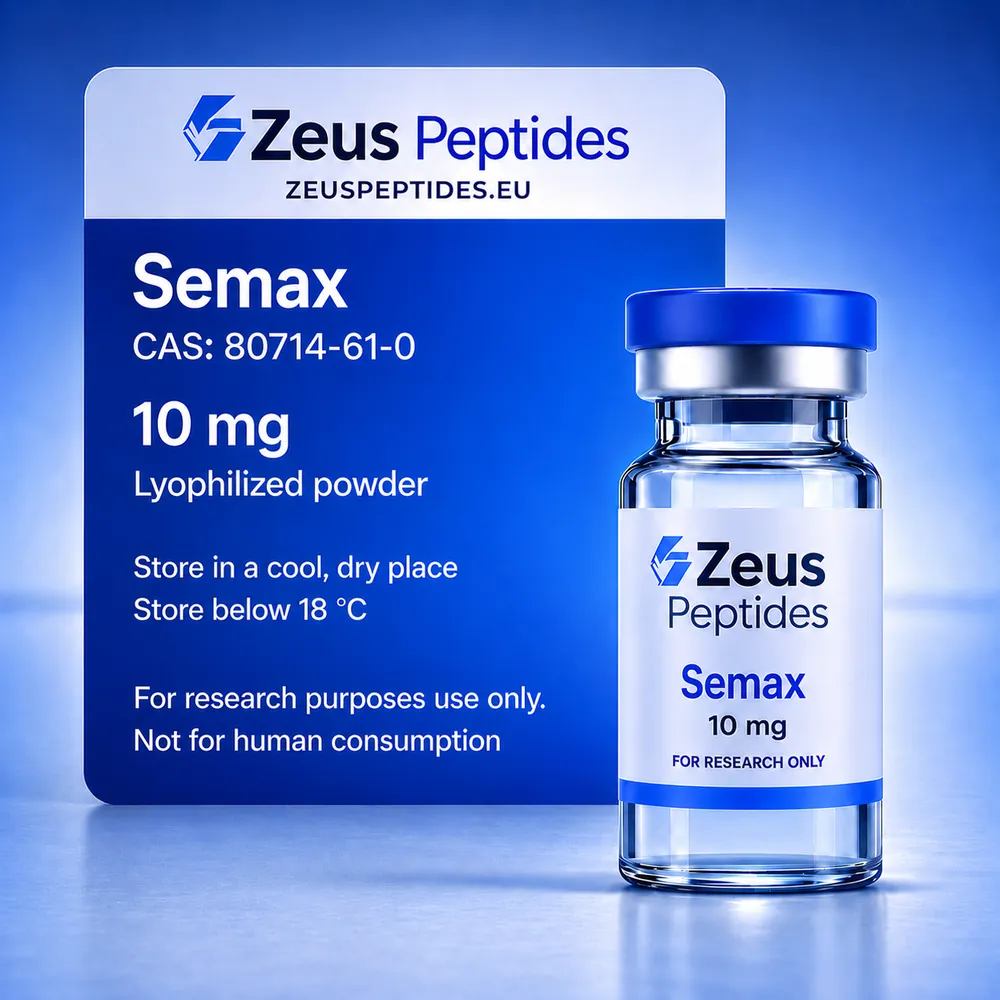
Selank and Semax are two synthetic peptides frequently mentioned together, as both were originally developed within Russian neuropharmacological research and both are classified as so-called "nootropic" research compounds. They are often searched for and compared with each other. This article discusses the origin, structure, and research areas of both peptides, based exclusively on published scientific literature.
What is Selank?
Selank is a synthetic analog of tuftsin, a naturally occurring immunomodulatory tetrapeptide. Researchers structurally modified tuftsin to improve stability, since the original tuftsin molecule is quickly broken down by peptidases under laboratory conditions. Selank was developed at the Institute of Molecular Genetics of the Russian Academy of Sciences, within a research line focused on peptides with possible effects on the central nervous system.
What is Semax?
Semax is a synthetic heptapeptide derived from a fragment of adrenocorticotropic hormone (ACTH), specifically the ACTH(4-10) fragment. As with Selank, the natural ACTH fragment lacks the stability needed for consistent laboratory research, and Semax was developed as a more stable analog. Semax, like Selank, was developed within Russian research institutions with a focus on neuropharmacology.
Why these two peptides are often researched and searched for together
Selank and Semax share a number of characteristics that explain why they frequently appear together in the literature and in search behavior:
- Both were developed within the same Russian research tradition in neuropharmacology.
- Both are classified in the literature as "nootropic" research compounds — a term referring to substances studied in relation to cognitive functions at the cellular level and in animal models.
- Both are derived from larger, naturally occurring peptides/hormones, stabilized for use in laboratory research.
Despite these similarities, the molecules differ considerably in structure and act on different signaling systems via different pathways, which makes them two distinct subjects of study.
Research areas around Selank
Immunomodulation in cell culture models
Because Selank is derived from tuftsin, a molecule with naturally occurring immunomodulatory properties, it is studied within in-vitro research on immune cell signaling.
Neuropharmacological research in animal models
Selank also appears in preclinical studies in rodents, where researchers examine neurochemical parameters, including pathways related to monoamine neurotransmitters, within strictly regulated research designs.
Research areas around Semax
ACTH fragment research and neurotrophic signaling pathways
Semax is studied in the literature in relation to neurotrophic signaling pathways, including research into BDNF-related (brain-derived neurotrophic factor) mechanisms in cell culture and animal models.
Preclinical research on cognitive processes in rodents
Part of the published literature on Semax concerns preclinical behavioral studies in rodents, in which researchers use learning- and memory-related paradigms to study neurobiological mechanisms. This is animal research within ethically reviewed protocols — not research in humans.
How scientists study these peptides
- In-vitro cell culture models: research into receptor binding and intracellular signal transduction.
- In-vivo animal models: preclinical studies in rodents at recognized research institutions, focused on neurochemical and behavioral parameters according to strict ethical protocols.
- Comparative structural research: analyses comparing Selank and Semax to their respective parent peptides (tuftsin and ACTH) to understand structure-function relationships.
Limitations of the current body of research
For both peptides, a significant part of the published research originates from a limited number of research groups, primarily from Russia and Eastern Europe. Scientists evaluating the broader literature point to:
- Limited independent replication of findings outside the original research groups.
- Methodological differences between studies that complicate comparison.
- The need for further, more broadly replicated research before more robust scientific conclusions are possible.
Frequently asked questions
Are Selank and Semax the same molecule?
No. They are two structurally different peptides with different molecular origins (tuftsin versus an ACTH fragment) that are often mentioned together because of their shared research history and classification as nootropic research compounds.
What does "nootropic" mean in this context?
In the literature, the term refers to substances studied in relation to cognitive processes at the cellular level and in animal models. It is a classification from the research literature, not a claim about effects in humans.
Are Selank and Semax approved as medicines in the EU?
No, not within the European Union. ZeusPeptides offers both peptides exclusively as research chemicals for qualified laboratories, not for use in humans or animals outside a recognized research setting.
Sources/References
- Neuropharmacological publications on tuftsin analogs and ACTH fragments.
- Preclinical studies on BDNF-related signaling pathways and immune cell modulation in peer-reviewed journals.
Interested in Selank or Semax for your laboratory research? View Selank and Semax in our range at ZeusPeptides.