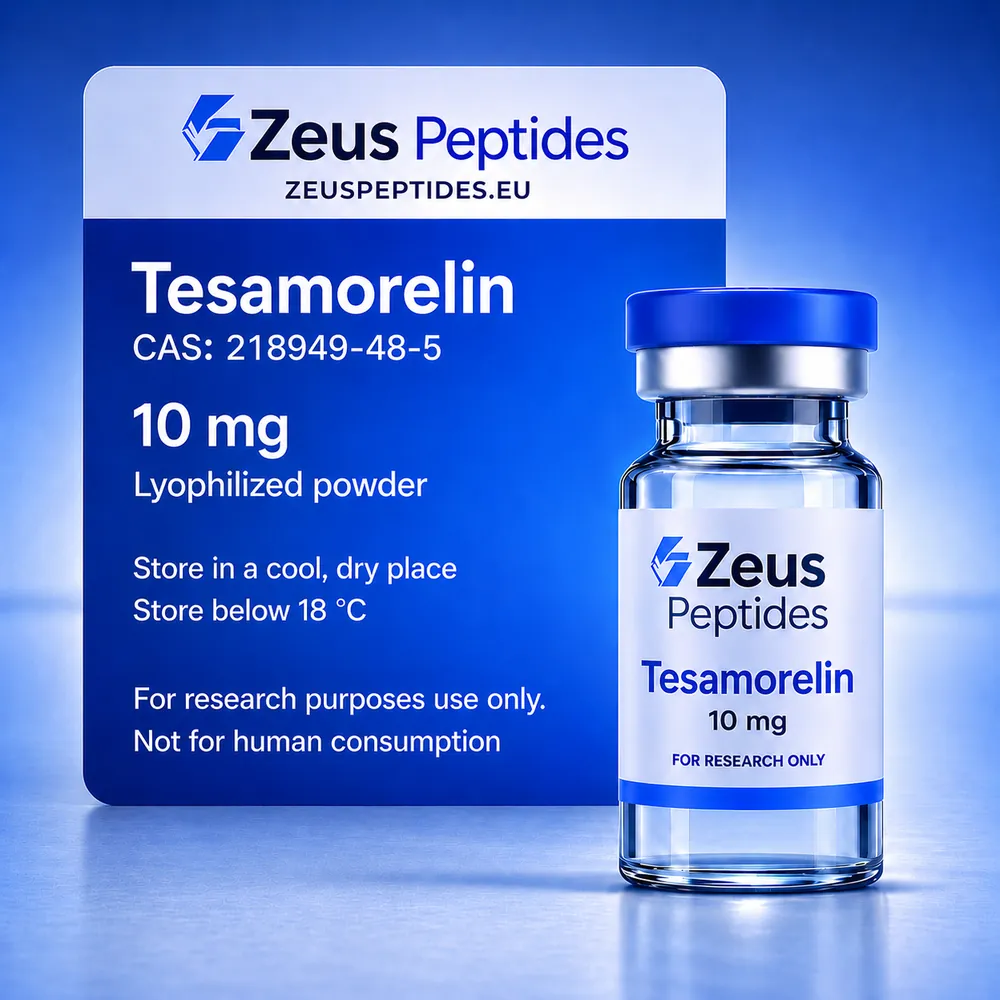
Tesamorelin is a synthetic peptide classified in the scientific literature as a growth hormone-releasing hormone (GHRH) analog. The molecule appears regularly in publications on the hypothalamic-pituitary axis and the regulation of growth hormone release. This article discusses what Tesamorelin is, how it is structurally composed, and which research areas it is studied within — based exclusively on published scientific sources.
What is Tesamorelin?
Tesamorelin is a modified analog of the naturally occurring growth hormone-releasing hormone (GHRH), a hypothalamic peptide that normally regulates the release of growth hormone by the pituitary gland. Researchers modified the structure of the natural GHRH molecule to improve the analog's stability, since the original GHRH is relatively quickly broken down by enzymatic activity under laboratory conditions.
In the literature, Tesamorelin is described as a molecule that acts on GHRH receptors in the anterior pituitary, making it a relevant subject of study within research on the neuroendocrine regulation of growth hormone release.
GHRH analog: the mechanism under study
Growth hormone-releasing hormone naturally plays a central role in a signaling cascade that begins in the hypothalamus and works through the pituitary to affect tissues throughout the body. Scientists study Tesamorelin specifically because, as a more stable analog, it is useful for investigating this signaling pathway more precisely under controlled laboratory conditions than is possible with the rapidly degrading natural GHRH.
This research into receptor activation and signal transduction is fundamental in nature: it aims to better understand the underlying endocrine mechanisms, not to establish applications in humans.
Research areas around Tesamorelin
Fundamental endocrinological research
A large part of the published literature on Tesamorelin concerns fundamental endocrinological research into the hypothalamic-pituitary axis. Researchers use the molecule to study the dynamics of growth hormone release in controlled experimental setups.
Research on body composition in clinical study populations
Tesamorelin has been the subject of clinical studies in specific, well-defined patient populations, published in peer-reviewed journals. This type of research falls outside the scope of this article and outside the intended use for which ZeusPeptides offers this substance: our products are intended exclusively for laboratory research by qualified researchers, not for use in humans.
Receptor pharmacology research
Alongside clinically oriented publications, there is a substantial body of receptor pharmacology research in which Tesamorelin is used as a tool to characterize GHRH receptor binding and subsequent signal transduction in cell models.
How scientists study Tesamorelin
Research into Tesamorelin proceeds along several methodological lines:
- In-vitro cell models: experiments measuring receptor binding and signal transduction at the molecular level, independent of a living organism.
- In-vivo animal models: preclinical studies in laboratory animals at recognized research institutions, focused on tracking endocrine responses according to strict ethical protocols.
- Published clinical studies: peer-reviewed publications in specific research populations, conducted by qualified medical research institutions — unrelated to the use of research chemicals as offered by ZeusPeptides.
Limitations of the current body of research
As with many GHRH analogs, researchers point to a number of recurring limitations in the literature:
- Differences in dosing protocols between studies (within the research design, not related to consumer use) complicate comparisons.
- The relatively short half-life of GHRH analogs in general poses methodological challenges for research designs.
- Long-term effects within research models remain the subject of ongoing study and require further, independently replicated data.
Frequently asked questions
What is the difference between Tesamorelin and natural GHRH?
Tesamorelin is a modified analog with an altered structure that improves stability compared to the natural GHRH molecule, making it more useful for laboratory research.
Is Tesamorelin the same as growth hormone itself?
No. Tesamorelin acts on the receptor that regulates the release of growth hormone; it is not growth hormone itself. In the literature it is classified as a GHRH analog (a secretagogue-like mechanism at the pituitary level).
Is Tesamorelin sold by ZeusPeptides for human use?
No. ZeusPeptides offers Tesamorelin exclusively as a research chemical for qualified laboratories and researchers. It is not intended, tested, or approved for use in humans or animals outside a recognized research setting.
Sources/References
- Endocrinological publications on the hypothalamic-pituitary-growth hormone axis.
- Receptor pharmacology studies on GHRH analogs in peer-reviewed journals.
Interested in Tesamorelin for your laboratory research? View Tesamorelin in our range at ZeusPeptides.